
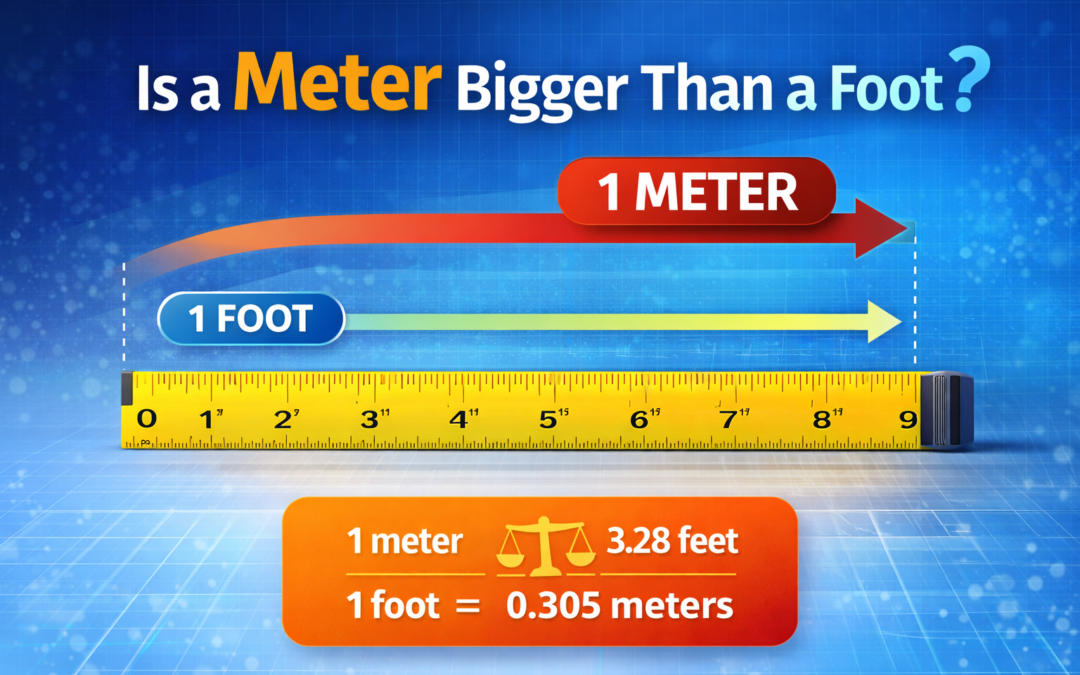
If you are asking, is a meter bigger than a foot, you are not alone because this comparison confuses many people in the United States. You often see meters used in science and international measurements, while feet remain common in American construction, sports, and daily life.
In this guide, you will get a precise answer, understand the math behind the conversion, and see practical examples that make the difference crystal clear so you can make accurate measurement decisions every time.
What Is a Meter and What Is a Foot?
A meter is the base unit of length in the International System of Units, which scientists and most countries use worldwide. A foot is a unit of length in the U.S. customary system, and it equals 12 inches. When you compare these two systems, you are essentially comparing a globally standardized metric unit with a traditional American measurement.
The meter was originally defined in the 18th century as a fraction of the Earth’s meridian, and it has since been refined using precise physical constants. The foot, on the other hand, evolved from historical body based measurements and later became standardized for consistency. Understanding this background helps you see why the two units differ so clearly in size and application.
Is a Meter Bigger Than a Foot? The Direct Answer
Yes, a meter is bigger than a foot, and the difference is not small. One meter equals approximately 3.28084 feet, which means a single meter is a little more than three feet long. When you picture that comparison, you immediately see that the meter covers much more length than one foot.
To put it simply, if you line up three one foot rulers end to end, you will still be slightly short of one full meter. That extra fraction makes a measurable difference in construction, engineering, and scientific calculations. When accuracy matters, that difference becomes critical rather than trivial.
The Exact Conversion Formula You Should Know
When you want to convert meters to feet, you multiply the number of meters by 3.28084. When you convert feet to meters, you multiply the number of feet by 0.3048. These precise factors ensure that you maintain high quality, error free calculations in professional or academic settings.
For quick reference, here are the core facts you should remember:
- 1 meter equals 3.28084 feet
- 1 foot equals 0.3048 meters
- 10 meters equal 32.8084 feet
These numbers allow you to move confidently between metric and U.S. customary systems without guesswork.
Real World Examples That Make the Difference Clear
Imagine a doorway that measures 2 meters tall, which equals about 6.56 feet. If you assumed a meter and a foot were similar in size, you would drastically underestimate that height. That misunderstanding could cause serious design or installation errors.
Now consider a 10 meter swimming pool lane, which converts to roughly 32.8 feet. That length is far longer than 10 feet, which highlights how misleading assumptions can be if you do not use the correct conversion factor. These examples prove that the answer to is a meter bigger than a foot has real world consequences.
Why the United States Still Uses Feet
You might wonder why feet remain common in the United States when most of the world uses meters. The answer lies in historical adoption, industry standards, and cultural familiarity. Construction codes, real estate listings, and athletic measurements in America still rely heavily on feet and inches.
For example, when you determine how many square feet your home contains, you are using a traditional measurement deeply embedded in U.S. practice. If you want to calculate area accurately, you can apply the methods explained in how to calculate square feet to avoid costly mistakes in flooring, painting, or renovation projects. Understanding square footage reinforces how central feet remain in American measurement systems.
Comparing Large Distances in Feet and Meters
When you compare larger distances, the size gap becomes even more obvious. A football field measures 100 yards between goal lines, which equals 300 feet, while that same distance is about 91.44 meters. Seeing both units side by side helps you grasp how a meter fits into large scale measurements.
If you are curious about sports field measurements, reviewing how many feet in a football field can give you additional context on how American sports standardize length. That comparison reinforces why a meter is bigger than a foot and how the two systems coexist. In practice, both units serve different communities and industries.
Practical Situations Where Conversion Matters
You often face meter to foot conversions when dealing with international products or specifications. Fitness equipment, imported furniture, and global engineering documents frequently list dimensions in meters. Without proper conversion, you risk ordering items that do not fit your intended space.
Suppose a product description says a table is 1.5 meters long, which equals roughly 4.92 feet. If you assume that means about one and a half feet, you would be off by more than three feet, which is a major planning error. Accurate decision making depends on understanding the true relationship between meters and feet.
Quick Estimation Tips for Everyday Use
You do not always need a calculator when making quick comparisons. Since one meter is just over three feet, you can multiply meters by three for a rough estimate and then add a small extra amount. This mental shortcut works well for informal planning or conversation.
However, for precise calculations, you should use the exact factor of 3.28084 rather than rounding too aggressively. Even small rounding errors can compound in large projects like framing, landscaping, or interior design. High precision ensures professional level results.
Using Online Tools for Accuracy
If you prefer not to handle the math manually, digital tools can simplify the process. A reliable calculator lets you instantly convert feet to meters without memorizing formulas. When accuracy and speed matter, using a tool can eliminate human error.
You can quickly convert feet to meters when working with international measurements or scientific data. This approach ensures your conversions remain consistent and dependable, especially when multiple dimensions are involved. Tools like this are particularly useful in academic, engineering, and construction contexts.
Common Misconceptions About Meters and Feet
One common misconception is that a meter is only slightly bigger than a foot, which is incorrect. In reality, a meter is more than three times longer than a foot. That misunderstanding often stems from unfamiliarity with the metric system in everyday American life.
Another mistake occurs when people assume that 3 feet equals exactly 1 meter, which is not true. Three feet equal 0.9144 meters, so they fall short of a full meter. That difference, while small in casual conversation, becomes important in professional settings.
How This Knowledge Helps You Make Better Decisions
When you understand that a meter is bigger than a foot, you can interpret specifications more confidently. Whether you are reading architectural plans, buying sports equipment, or comparing international data, you avoid costly misjudgments. Knowledge of precise measurement strengthens your analytical and planning skills.
In the United States, where both metric and customary systems appear in different contexts, this clarity is especially valuable. Scientific research, medicine, and global commerce rely heavily on meters, while daily life still uses feet. Being fluent in both systems gives you a measurable advantage.
Conclusion
So, is a meter bigger than a foot, and by how much does it matter? A meter equals approximately 3.28084 feet, which makes it more than three times longer than a single foot. When you understand this relationship, you eliminate confusion, improve measurement accuracy, and make informed decisions in construction, education, sports, and everyday planning.
By mastering the exact conversion factors and recognizing real world examples, you gain practical confidence in both metric and U.S. customary systems. Whether you calculate room dimensions, interpret international specifications, or compare athletic distances, you now know precisely how meters and feet relate. That clarity empowers you to measure, plan, and build with precision rather than assumption.